Archives

London Visiting Steinways

Steinways Pianos and Human Harps

Harpist Olivia Jageurs, documentarian Jesse Lawrence and Di met at Steinways in London, to explore the similarities between the latest version of the Human Harp and a piano...

We were very lucky to meet Steinway’s chief technician Ulrich who kindly spent a couple of hours revealing and explaining the beautiful inner engineering of a Steinway concert grand.

“There is no one individual who can answer the question ‘how do you play a suspension bridge’ so it made sense to speak to a specialist like Ulrich who understands the inner workings of a piano – which behaves in a similar way to our new design”  Di Mainstone

London Roundhouse Live-Lab

Unleashing the Voice of the Roundhouse

THE LAUNCH OF HUMAN HARP LIVE-LAB, TOOK PLACE AT THE ROUNDHOUSE THROUGHOUT AUGUST 2014. ARTIST DI MAINSTONE AND A TEAM OF ENGINEERS, MUSICIANS, DESIGNERS AND DANCERS COLLABORATED FROM A POP-UP LABORATORY LOCATED ON THE VENUE’S 1ST FLOOR. DESIGNING, BUILDING, TESTING AND PERFORMING - THE LATEST VERSION OF THE HUMAN HARP...

Dates:  4th – 25th August 2014 Opening hours:  12-5pm, Monday – Friday (+ REVERB weekend 21 – 23rd August)
Location: The Roundhouse, Torquil’s Bar, 1st Floor Bar by the rooftop beach, Chalk Farm Road, NW1 8EH

HUMAN HARP LIVE-LAB EVENT
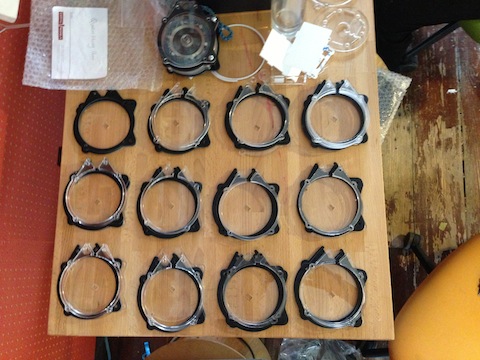
Human Harp’s LIVE-LAB was a pop-up laboratory situated on the first floor of the Roundhouse which opened to the public for the month of August thanks to funding from Queen Mary University of London (QMUL), the Arts Council’s Grants for the Arts and the Roundhouse.  Visitors were invited to test twelve new Human Harp instruments that were developed specifically to play the structure of the Roundhouse.   They were also be able to enjoy workshops, talks and pop-up performances.  We gave visitors a unique opportunity to interact with our new sonic instrument – enabling our team to develop the device both artistically and technically.  Human Harp documentarian Jesse Lawrence filmed our activities which are all available on this Roundhouse post.

THE VOICE OF THE ROUNDHOUSE 
The team realised that if the Human Harp could play a giant bridge it could very possibly play an industrial building like the Roundhouse.  With this in mind, Di and her collaborators will answer the question “Can the Human Harp unleash the voice of the Roundhouse?”  Responding to the building’s acoustics and structure, the team will be on site to test the latest sound control systems, sharing ideas with the venue’s visitors as well as fellow artists and scientists.

THE TEAM
During the Human Harp LIVE-LAB at the Roundhouse the public had the opportunity to meet our London team, made up from students and researchers from QMUL and engineers, musicians and designers from East London.  Louis McCallum is a current PhD student in the MAT programme at QMUL. Becky Stewart and Adam Stark completed PhDs within the School of Electronic Engineering and Computer Science at QMUL in 2010 and 2011.


London Goldsmiths NIME Workshop

As a part of NIME 2014

The Human Harp is a project led by artist Di Mainstone with hardware and software engineering by Becky Stewart and Adam Stark. The project draws inspiration from suspension bridges and explores how they can be transformed into musical instruments through augmentation with physical computing interfaces.

Our 3 hour NIME workshop was held at Goldsmiths and lead participants through the hardware and software central to the Human Harp - in particular the hardware string interface and the sound generation software. Participants were able to get hands-on experience programming and testing the Arduino-based hardware and then a guided tour through the software generating the audio.

BB9

Programme

The Human Harp is an open source project that is releasing all associated code and design files under creative commons and open source licenses. However, not all members of the NIME community may be comfortable with programming Arduinos and setting up bespoke physical interfaces. In this workshop, participants will be guided through how to install and test microcontroller code using the Arduino environment and then using the data stream generated by the Arduino to control audio playback.

The workshop introduced the Human Harp project framed within its artistic and technical objectives. The participants were able to physically interact with the different modules of the installation that generate audio before being led through the microcontroller code and audio software. By the end of the workshop, participants learned how to access open source software on Github and set up a Human Harp for their own development.

The workshop started with a talk from Di Mainstone about the creative inspiration for the piece and the history of the project. The current prototype of the physical computing interface will be demonstrated and then workshop attendees will be led through the technology.

By the end of the workshop, participants learned how to robustly develop hardware and software for live performance through the case study of the Human Harp. They gained hands-on experience programming and testing hardware built around the Arduino toolchain along with software frameworks, using tools common to open source communities such as Github.

London Piano Hammers & Human Harps

How Do We Make the Roundhouse Dong?

 “A friend found the carcass of a piano on the street and dragged it into my studio one day. Struck by its beauty, I started playing with the felt hammers inside and occurred to me that this mechanism might be a good way to release the sound of the cables on Clifton Suspension Bridge. More immediately it would be a great way to play the columns of Roundhouse venue.

Researcher Louis McCallum and I got together at my studio to explore ways to design the “hammer” or as we christened it the “donger”.  Louis is currently studying for his PhD in Musical Robotics as part of the Media and Arts Technology Programme at Queen Mary, University of London.  I was excited to work with Louis as he has a brilliant background in instrument design, in particular hacking pianos!  We spent the first part of our day discussing the sounds we wanted to create and also how we wanted the donger device to look and move.  Louis then set to work building the prototype with industrial designer David Blair Ross.”
DI MAINSTONE

London Technology for the Human Harp

Can We Make It to the Bridge in Time?

After returning from Copenhagen, the team had 6 weeks to reach their first deadline - the 130th anniversary of the Brooklyn Bridge on May 24th 2013. The team's aim was to make 8 functioning harp notes, and film Hollie Miller testing them on the Brooklyn Bridge in time for the anniversary. Creators Project had agreed to make a mini documentary of their adventure.  

Becky Stewart, Adam Stark and Jon Nussey were developing the hardware and software that would run the instrument. Technical producer Becky explored ways of measuring the length, speed and angle of the string, consulting with Dave Meckin and fellow Media Arts and Technology student Laurel Smith-Pardue.

“Andrew McPherson our mentor at QMUL suggested that we use photo resistors strategically placed at the hole where the sting exits the module. As the sting shifts angle, each sensor would recognise the shift in light. Initial tests with 4 light dependent resistors showed that this was possible, but generated noisy signals that were difficult to calibrate. We then looked to infrared light to reduce the noise and calibration issues. This worked well with a single IR emitter and detector pair, but more investigation into different packages of emitters and the number of detectors is needed”  BECKY STEWART

Sound designer and software developer Adam Stark came on board to design the Human Harp sound software, exploring how the movician’s interaction with the string might compose harvested sounds from the bridge.

“The Human Harp modules will communicate with different software packages such as Max to generate sound. A driver will take in the serial data from the Arduino and translate it into Open Sound Control (OSC) messages that any OSC client can receive” ADAM STARK

Creative technologist John Nussey joined the team in the final month before NYC, to find elegant ways to embed the sensors, batteries and mini Arduino-mini into the harp note. The team completed their mission and 8 harp notes were fabricated. Di, Hollie and Anna packed them into a suitcase and set off for NYC!

London Movician’s Holster

How do you connect a Movician to a Bridge?

Next, Di built a wearable holster around Hollie that would connect her body to the bridge via the Human Harp’s retractable strings. This holster needed to be both rigid and flexible and they decided to work with leather.

“We knew the holster needed to be solid so that it would not pull away from the body and prevent the movician from sensing the tension and pull of the harps strings that would be fixed to it. It also needed to have the capability to expand and contract like an armadillo or a piece of plate armour, and as such became a mechanism in its own right” Di Mainstone

Working with product designer, Lea Aubertin, the team devised a plug-like device that contained magnets to connect the retractable chords to the holster. The plug was created in Rhino, ensuring that it could be made using fab-lab tools (laser cutter) as part of the open-source concept.

“During the workshops at CIID we explored ways of clipping the strings to holsters on the body. We investigated karabiner clips, hooks and magnets. Of all the iterations, magnets felt the most fluid way to apply and reapply the strings to the body” DI MAINSTONE

Throughout this process Hollie would try on the prototype and move and test out various actions to see if the form of the harness would enable the movician to move in a free way.

“In many ways the function of the Human Harp and the needs of the movician, informed our aesthetic choices for the holster” Hollie Miller


London The Bridge Player: Movician

How does a Movician play the bridge?

Di Mainstone began her research by exploring the role of a bridge player with dancer Hollie Miller, who subsequently became Human Harp's original movician. The movician was a player of the Human Harp who controlled the sounds of the bridge via their body movement and interaction with the Human Harp's string like interface which connected to the bridge.

“We observed that the string mapped Hollie’s position via a physical line from its origin onto her body. We liked the physical aspect of the string as a sound tool (rather than motion tracking for example) as it allowed the movement of the user (or movician) to be plotted in a sculptural way, creating a visible trace between the performer and the bridge” Di Mainstone

Next, Di built a wearable holster around Hollie that would connect her body to the bridge via the Human Harp. This holster needed to be both rigid and flexible and they decided to work with leather.

“We knew the holster needed to be solid so that it would not pull away from the body and prevent the user (movician) from sensing the tension and pull of the harps strings that would be fixed to it. It also needed to have the capability to expand and contract like an armadillo or a piece of plate armour, and as such became a mechanism in its own right” Di Mainstone

Working with product designer, Lea Aubertin, the team devised a plug-like device that contained magnets to connect the retractable chords to the holster. The plug was created in Rhino, ensuring that it could be made using fab-lab tools (laser cutter) as part of the open-source concept.

“During the workshops at CIID we explored ways of clipping the strings to holsters on the body. We investigated karabiner clips, hooks and magnets. Of all the iterations, magnets felt the most fluid way to apply and reapply the strings to the body” DI MAINSTONE

London Queen Mary University of London

How Do We Design a Bridge Sound Controller?

Back in London, Di Mainstone spoke to professor Mark Plumbley at the Centre for Digital Music at Queen Mary University of London to secure support for the first version of the Human Harp...

“I thought it would be interesting if this bridge instrument used harp-like strings to control the harvested environmental sounds – mirroring the elegant cables of a suspension bridge” DI MAINSTONE

Di consulted Dave Meckin, a PHD student at the Media Arts and Technology group at QMUL. Dave and Di had used string in a similar way for a collaborative project called Whimsichord, so he had strong ideas on which sensors would be appropriate to measure the pull, length and twang of the string. Keen to make the harp as versatile as possible, Di envisaged something that was modular, bendy and magnetic, so that it could be set up at any location to take on the shapes of the urban environment.

“I saw this as an instrument for urban sound interventions. It should be assembled and pulled down swiftly and with ease. Because of this, it made sense to create segments that could clip together like a caterpillar, or stand-alone as single modules. Each module would be magnetic or clip-on so that it could attach to most metals and surfaces without damaging the integrity of the structure” DI MAINSTONE

Di connected with industrial designer David Blair-Ross, to investigate the housing and mechanical engineering of the bridge sound controller – which was now named the harp note. The pair decided that the module would be transparent so that the structure of the bridge was visible through each segment.

“This transparency suited the open-source nature of the project, making visible the mechanical and digital technology within. On a practical level, we wanted to make sure the module was weather proof and would also withstand being dropped, and so incorporated a rubber washer in the design” DI MAINSTONE

The team wanted to make sure that the design could be downloaded and reproduced by researchers and students using a laser cutter. David Blair Ross produced a 3d model of a module, and fabricated the first prototype.

“Before heading off to Copenhagen we met with our technical producers, Becky Stewart and Adam Stark to discuss how all of the digital elements would fit inside the harp casing. Each module needed to contain a spring, a spool, 8 meters of string, 2 kinds of sensor, an Arduino-mini and batteries.” DI MAINSTONE